 Pin it
 My neighbor called me in a panic two days before her daughter's graduation party—the baker had fallen through, and she needed a cake for 24 people. I'd never made a sheet cake before, but something about the urgency made me confident. Standing in my kitchen at 6 a.m. with coffee in hand, I realized this wasn't just about mixing flour and butter; it was about showing up when it mattered. That cake became the unexpected star of the party, and I learned that sometimes the best recipes are born from a little bit of pressure and a lot of heart.
I'll never forget frosting that cake while my neighbor's family arrived early, grandparents peeking into the kitchen asking if they could help. We ended up making it together—her daughter piping on the school colors while her mom laughed at my slightly lopsided corners. By the time the cake hit the table, it didn't matter that it wasn't perfectly symmetrical; it was made with hands that cared, and that's what people remembered.
Ingredients
- All-purpose flour (3 cups): The foundation that keeps this cake tender without being dense; make sure it's fresh because old flour can make everything taste flat.
- Baking powder & baking soda (2½ tsp & ½ tsp): These two work together to give you that pillowy crumb—don't skip the baking soda or your cake will taste slightly soapy.
- Salt (½ tsp): A pinch that makes the vanilla sing and balances the sweetness in a way people can't quite name.
- Unsalted butter (1 cup for cake, 1 cup for frosting): Room temperature is non-negotiable; cold butter won't cream properly and you'll end up with a grainy, disappointing result.
- Granulated sugar (2 cups): This dissolves into the butter to create air pockets, which is literally what makes your cake fluffy and not dense.
- Eggs (4 large): Room temperature eggs blend smoothly into the batter; cold ones create lumps that won't fully incorporate.
- Vanilla extract (1 tbsp for cake, 2 tsp for frosting): Use the real stuff—imitation vanilla tastes thin and slightly plastic-y in something this simple.
- Whole milk (1½ cups for cake, ¼ cup for frosting): Room temperature milk keeps everything emulsified and smooth; cold milk can break the batter.
- Powdered sugar (4 cups sifted): Sifting removes lumps that would otherwise ruin your beautiful frosting texture.
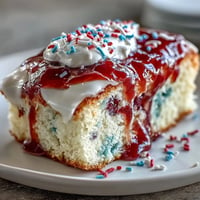
- Graduation-themed sprinkles: The cherry on top that makes this feel celebratory—pick your school colors and lean into it.
Tired of Takeout? 🥡
Get 10 meals you can make faster than delivery arrives. Seriously.
One email. No spam. Unsubscribe anytime.
Instructions
- Set your stage:
- Preheat the oven to 350°F and grease that 12x18-inch sheet pan like you mean it—use parchment paper so the cake releases without any drama. Get your ingredients out and arrange them like you're about to perform, because temperature and readiness matter more than you'd think.
- Build your dry foundation:
- Whisk flour, baking powder, baking soda, and salt together in a medium bowl—this aerates the flour and distributes the leavening agents evenly. Set it aside and let it breathe while you move to the next step.
- Cream butter and sugar:
- Beat butter and sugar for about 3 minutes until it's pale, fluffy, and looks almost like clouds. You'll know it's ready when you can't see individual sugar granules and the mixture has doubled in volume.
- Add eggs one at a time:
- Drop each egg in individually and beat well after each one—this prevents a broken-looking batter and ensures everything emulsifies properly. If the mixture looks slightly curdled, don't panic; the dry ingredients will bring it back together.
- Alternate your wet and dry:
- Add half the dry mixture, mix gently on low speed, then half the milk, mixing until just combined—this technique prevents overmixing and keeps your crumb tender. Repeat with the remaining halves, scraping down the bowl as you go.
- Into the pan:
- Pour the batter into your prepared pan and smooth it out with a spatula—aim for an even layer so it bakes uniformly. You'll see little bubbles trying to escape; let them be.
- Bake with confidence:
- Slide it into the oven for 28-32 minutes, watching for the toothpick test around minute 28. The cake is done when a toothpick inserted in the center comes out clean or with just a few moist crumbs clinging to it.
- Cool completely:
- Let the cake cool in the pan on a wire rack—this prevents warping and makes frosting easier. Patience here pays off; a warm cake will melt your frosting into a puddle.
- Make your frosting:
- Beat softened butter for 2 minutes until it's pale and creamy, then gradually add sifted powdered sugar while mixing on low to avoid a sugar cloud. Add vanilla, milk, and salt, then beat on high for 2-3 minutes until it's fluffy enough to hold peaks.
- Frost like you own it:
- Spread the buttercream evenly over the cooled cake using an offset spatula or the back of a spoon. Work from the center outward and don't worry about perfection; character is charming.
- Celebrate with color:
- Scatter graduation-themed sprinkles or your school colors across the top while the frosting is still soft enough to grab them. This is the moment it stops being just cake and becomes a memory in edible form.
 Pin it
 Watching that cake disappear at the graduation party—people asking for the recipe, taking photos, loading up paper plates with seconds—made me realize I'd stumbled onto something bigger than a dessert. It was proof that sometimes showing up and trying something new is exactly what's needed in a moment that matters.
The Science of Tender Cake
The reason this cake stays so soft isn't magic; it's the ratio of wet to dry ingredients and the careful alternating of them. Butter and sugar trap air when creamed together, eggs add moisture and richness, and milk keeps everything hydrated without making the cake soggy. Every ingredient has a job, and when they all show up on time and ready to work, you get something that melts on your tongue instead of crumbling all over the plate.
Frosting Texture Tricks
If your buttercream ends up too thick and won't spread, warm your spatula under hot water and dry it between strokes to help smooth things out. If it's too soft and sliding off, pop it in the fridge for 15 minutes to firm up, then try again. The temperature in your kitchen matters too—if your house runs warm, chill the frosting longer and work faster.
Making It Your Own
This is the skeleton recipe, but it's begging to be personalized. Some people add ½ teaspoon of almond extract to the batter for subtle depth, while others fold in lemon zest to brighten everything up. You could pipe the frosting into decorative swirls, write a message with gel food coloring, or go minimalist with just the school colors sprinkled across the top.
- Add ½ teaspoon almond extract to the batter if you want a warm, slightly mysterious flavor underneath the vanilla.
- Tint the frosting with your school colors or make it match the graduate's favorite shade—just add gel coloring a tiny drop at a time.
- Use piping bags and tips to create borders, write names, or pipe graduation caps and scrolls if you're feeling fancy and have a little time.
 Pin it
 This cake has become my go-to for celebrations because it's foolproof, feeds a crowd, and tastes like someone actually cared enough to bake. Make it for a graduation, a birthday, or just a Tuesday that needs a little sweetness.
Recipe Q&A
- → What is the best pan size for this cake?
A 12x18-inch half-sheet pan is ideal for baking this vanilla sheet cake evenly.
- → Can I add extra flavor to the cake batter?
Yes, adding ½ teaspoon of almond extract to the batter enhances the flavor nicely.
- → How long should I bake the cake?
Bake at 350°F (175°C) for 28–32 minutes, or until a toothpick comes out clean.
- → Is the buttercream easy to customize?
Absolutely, the vanilla buttercream can be tinted with gel food coloring to match any theme.
- → Can this cake be made gluten-free?
Yes, substitute the all-purpose flour with a 1:1 gluten-free baking blend for a gluten-free version.